

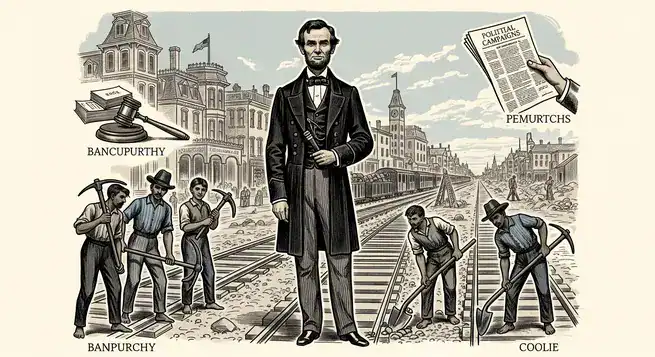
Nineteenth-century American life held many surprising obstacles for those pursuing professional success. From strict military standards to the harsh realities of bankruptcy, expectations for public figures were often rigid and unforgiving.
This quiz examines how individuals navigated these challenges, covering everything from the labor systems behind infrastructure projects to the political paths taken by future leaders. You will see questions about specific social norms and the legal consequences that shifted as the country grew.
If you enjoy learning about the past, check out our general history trivia, read more about war cinema studies, or browse our pioneer biographies.
Which future U.S. President was initially discouraged from a military career due to being deemed too tall for standard infantry requirements?
Abraham Lincoln
Abraham Lincoln
Charlie Chaplin
Charlie Chaplin
Franklin D. Roosevelt
Franklin D. Roosevelt
Winston Churchill
Winston Churchill
In the 19th century, the term ‘Coolie’ historically referred to indentured laborers who often faced extreme hazards primarily in the construction of which extensive transportation networks?
Mining operations
Mining operations
Dock labor
Dock labor
Textile manufacturing
Textile manufacturing
Railroad work
Railroad work
In the 19th century, what was a common legal repercussion for individuals experiencing severe personal bankruptcy?
Financial data was not recorded
Financial data was not recorded
Only corporations could go bankrupt
Only corporations could go bankrupt
Bankruptcy protections were unavailable
Bankruptcy protections were unavailable
Creditors could imprison debtors
Creditors could imprison debtors
Many notable historical figures began their local political career by serving in which of these state-level bodies?
State Legislature
State Legislature
City Council
City Council
School Board
School Board
County Coroner
County Coroner
In the late 1800s, laborers often classified as ‘coolies’ faced extreme hazards during which major infrastructure project?
The American Civil War
The American Civil War
The construction of the Transcontinental Railroad
The construction of the Transcontinental Railroad
The California Gold Rush
The California Gold Rush
The Industrial Revolution in Britain
The Industrial Revolution in Britain
How was personal bankruptcy typically viewed in the mid-19th century entrepreneurial environment?
It was a mandatory step for political office seekers
It was a mandatory step for political office seekers
It allowed for immediate government funding
It allowed for immediate government funding
It rarely affected one’s credit worthiness
It rarely affected one’s credit worthiness
A failed business venture often led to social ostracization
A failed business venture often led to social ostracization
Which soft skill was most essential for mid-1800s candidates to advance their political career through stump speeches?
Legal training
Legal training
Public speaking skills
Public speaking skills
Military leadership experience
Military leadership experience
Wealthy family connections
Wealthy family connections
Abraham Lincoln, known for his physical stature, stood at approximately what height?
Five feet eleven inches
Five feet eleven inches
Six feet two inches
Six feet two inches
Six feet four inches
Six feet four inches
Six feet six inches
Six feet six inches
Which major 19th-century financial crisis contributed to widespread personal bankruptcies among early American businessmen?
The Panic of 1893
The Panic of 1893
The Panic of 1873
The Panic of 1873
The Panic of 1837
The Panic of 1837
The Great Depression
The Great Depression
Which party, known for its opposition to the Democratic Party in the mid-19th century, saw many rising politicians begin their career within its ranks?
The Free Soil Party
The Free Soil Party
The Federalist Party
The Federalist Party
The Whig Party
The Whig Party
The Know-Nothing Party
The Know-Nothing Party
What was a common ‘near-fatal’ cause of injury for railroad laborers in the high-risk environments of the 1860s?
Pneumonia resulting from site conditions
Pneumonia resulting from site conditions
Malaria outbreaks in swampy work zones
Malaria outbreaks in swampy work zones
Falling from heights while scaffolding
Falling from heights while scaffolding
Explosives accidents during tunnel construction
Explosives accidents during tunnel construction
Which U.S. federal legislation finally provided a more comprehensive and standardized system for handling personal bankruptcy?
The Debtors’ Relief Act
The Debtors’ Relief Act
The Homestead Act
The Homestead Act
The National Banking Act
The National Banking Act
The Bankruptcy Act of 1898
The Bankruptcy Act of 1898
In the 19th century, why was there sometimes a height limit for specific military recruitment roles?
Being too tall could disadvantage cavalry horses
Being too tall could disadvantage cavalry horses
Being too tall made uniforms impossible to manufacture
Being too tall made uniforms impossible to manufacture
Being too tall meant a soldier required too much food rations
Being too tall meant a soldier required too much food rations
Being too tall could reveal a soldier’s position in trench warfare
Being too tall could reveal a soldier’s position in trench warfare
Which highly distributed print medium served as a primary tool for a candidate’s *direct campaign messaging* when launching a local political career in the mid-19th century?
Public debates
Public debates
Local newspaper advertisements
Local newspaper advertisements
Letters to the editor
Letters to the editor
Political pamphlets and broadsides
Political pamphlets and broadsides
Beyond specific regional diseases, what was a common underlying primary driver for the high mortality rate among imported manual laborers in the 19th century?
Violent conflicts with indigenous populations
Violent conflicts with indigenous populations
Frequent natural disasters
Frequent natural disasters
Extreme malnutrition
Extreme malnutrition
Extensive industrial accidents
Extensive industrial accidents
What was a common social consequence of bankruptcy in the 19th century regarding one’s aspirations?
It often prevented individuals from holding public office
It often prevented individuals from holding public office
It rarely affected personal reputation in business circles
It rarely affected personal reputation in business circles
It allowed for automatic entry into government civil service positions
It allowed for automatic entry into government civil service positions
It was entirely forgiven by the tax authorities after seven years
It was entirely forgiven by the tax authorities after seven years
Which narrative arc best describes typical ‘rags-to-riches’ political biographies in 19th-century American history?
A former railroad contractor who entered politics after a business failure
A former railroad contractor who entered politics after a business failure
A labor organizer who rose from the railroad camps to the national stage
A labor organizer who rose from the railroad camps to the national stage
A lawyer who famously overcame financial ruin to become a statesman
A lawyer who famously overcame financial ruin to become a statesman
A military officer who was discharged for his height before winning office
A military officer who was discharged for his height before winning office
The ‘Coolie’ system was famously employed to fill labor shortages in the 19th century after the abolition of slavery, particularly where?
Constructing port facilities in Southeast Asia
Constructing port facilities in Southeast Asia
Providing labor for sugarcane plantations in the Caribbean
Providing labor for sugarcane plantations in the Caribbean
Clearing forests for farming in the frontier states
Clearing forests for farming in the frontier states
Building telegraph lines across the Andes mountains
Building telegraph lines across the Andes mountains
Why did 19th-century society stigmatize bankrupt individuals so severely?
Because it hurt the local tax base for the municipality
Because it hurt the local tax base for the municipality
Because the government had no laws to manage it efficiently
Because the government had no laws to manage it efficiently
Because it was seen as a sign of moral failing
Because it was seen as a sign of moral failing
Because it was associated with foreign speculative investment
Because it was associated with foreign speculative investment
Historical accounts suggest height restrictions were often inconsistently applied during which mid-19th century conflict?
Standardizing the height for volunteer state militias
Standardizing the height for volunteer state militias
Standard height for members of a Governor’s bodyguard unit
Standard height for members of a Governor’s bodyguard unit
Requirements for officers in the Union Army
Requirements for officers in the Union Army
Recruitment standards for infantry during the Mexican-American War
Recruitment standards for infantry during the Mexican-American War
What major political development in the early-to-mid-19th century widened the path for individuals to launch a successful political career?
The invention of the telegraph for political organizing
The invention of the telegraph for political organizing
The expansion of the voting franchise to non-landowners
The expansion of the voting franchise to non-landowners
The centralization of newspaper media in major cities
The centralization of newspaper media in major cities
The rise of the steam locomotive
The rise of the steam locomotive
What factor eventually contributed significantly to the decline of the international coolie labor system in the late 19th century?
The 1848 revolutions in Europe and their impact on global labor laws
The 1848 revolutions in Europe and their impact on global labor laws
The shift toward mechanized agriculture reducing manual labor demands
The shift toward mechanized agriculture reducing manual labor demands
The diplomatic pressures on China leading to the end of the coolie trade by 1874
The diplomatic pressures on China leading to the end of the coolie trade by 1874
The transition from indentured servitude to wage labor systems in the 1880s
The transition from indentured servitude to wage labor systems in the 1880s
You can do better
Not bad
Great!
When you finish this round, keep going with other topics like classic western films, notable academy award history, or the silent film era.