


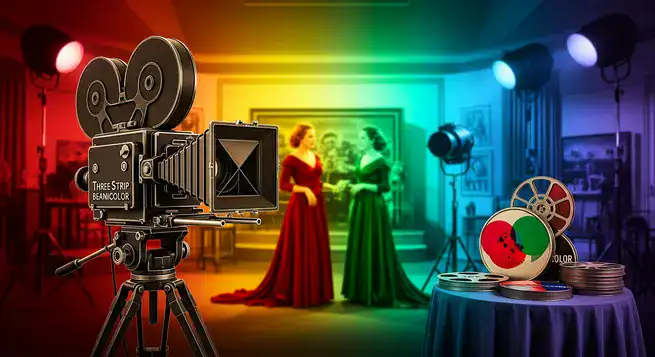

Technicolor changed how movies looked, moving from black and white to vibrant, saturated hues. This process defined the visual style of Hollywood for decades.
This quiz focuses on the mechanics of three-strip cameras, the color advisory roles, and technical breakthroughs. You will answer questions about how legendary films achieved their signature looks.
After testing yourself here, see how much you know about color milestones, cinematography secrets, or the golden age of film.
What was the name of the sophisticated Technicolor motion picture system that used three separate B&W negative strips to capture primary colors?
Hand-tinting
Hand-tinting
Eastmancolor
Eastmancolor
Two-strip process
Two-strip process
Three-strip process
Three-strip process
In the three-strip Technicolor process, the camera used a prism to separate light into which three primary color records?
Blue, Red, Yellow
Blue, Red, Yellow
Cyan, Magenta, Yellow
Cyan, Magenta, Yellow
Red, Yellow, Blue
Red, Yellow, Blue
Red, Green, Blue
Red, Green, Blue
Which 1935 production holds the distinction of being the first feature-length film to use the full three-strip Technicolor process?
The Adventures of Robin Hood
The Adventures of Robin Hood
Gone with the Wind
Gone with the Wind
Becky Sharp
Becky Sharp
The Wizard of Oz
The Wizard of Oz
What title was given to the experts, such as Natalie Kalmus, who oversaw the color harmony and saturation of Technicolor productions?
Gaffer
Gaffer
Production Designer
Production Designer
Color Consultant
Color Consultant
Cinematographer
Cinematographer
Which iconic 1939 film used the three-strip process to create a stark contrast between sepia-toned Kansas and vibrant, colorful Oz?
Gone with the Wind
Gone with the Wind
Fantasia
Fantasia
Meet Me in St. Louis
Meet Me in St. Louis
The Wizard of Oz
The Wizard of Oz
In which decade did the film industry largely transition from the bulky three-strip Technicolor cameras to single-strip film stocks like Eastmancolor?
1950s
1950s
1930s
1930s
1960s
1960s
1940s
1940s
Which of the following was NOT a primary advantage of Eastmancolor over the three-strip process?
It was cheaper to use
It was cheaper to use
It used the same cameras as black-and-white film
It used the same cameras as black-and-white film
It did not require a prism
It did not require a prism
It allowed for better resolution
It allowed for better resolution
Who served as the head of the Technicolor Color Advisory Service and worked on hundreds of three-strip films?
Busby Berkeley
Busby Berkeley
Jack Cardiff
Jack Cardiff
Natalie Kalmus
Natalie Kalmus
Herbert Kalmus
Herbert Kalmus
Which British production, set in a remote Himalayan convent, is widely celebrated for its intense three-strip Technicolor use to convey the psychological unraveling of nuns?
The Red Shoes
The Red Shoes
The Thief of Baghdad
The Thief of Baghdad
A Matter of Life and Death
A Matter of Life and Death
Black Narcissus
Black Narcissus
The final Technicolor prints were created using which specific high-quality printing process, known for its longevity and color depth?
Prismatic separation
Prismatic separation
Dye-Imbibition printing
Dye-Imbibition printing
Trilithic filtering
Trilithic filtering
Magenta dye transfer
Magenta dye transfer
What was a major operational challenge for cinematographers using the three-strip Technicolor cameras on location?
The three-strip camera was incompatible with sound recording
The three-strip camera was incompatible with sound recording
The three-strip camera required massive amounts of light on set
The three-strip camera required massive amounts of light on set
The three-strip camera was too small
The three-strip camera was too small
The three-strip camera was too quiet
The three-strip camera was too quiet
In what year did Eastman Kodak introduce the first commercially successful 35mm color negative film, signaling the beginning of the end for three-strip Technicolor?
1958
1958
1941
1941
1965
1965
1950
1950
What legal development significantly contributed to the decline of Technicolor’s monopoly on color filmmaking?
Technicolor ceased hardware production to focus on software
Technicolor ceased hardware production to focus on software
Technicolor colors faded quickly
Technicolor colors faded quickly
Technicolor was forced to open their process to rival studios following antitrust litigation
Technicolor was forced to open their process to rival studios following antitrust litigation
Technicolor was too expensive to process
Technicolor was too expensive to process
Which renowned cinematographer received an Academy Award for his work on the three-strip Technicolor film ‘Black Narcissus’?
Jack Cardiff
Jack Cardiff
Michael Curtiz
Michael Curtiz
Victor Fleming
Victor Fleming
Rouben Mamoulian
Rouben Mamoulian
How did the chemical structure of Eastmancolor differ from the three-strip Technicolor camera negative?
Eastmancolor only captured two colors
Eastmancolor only captured two colors
Eastmancolor was a single-strip integrated tri-pack film
Eastmancolor was a single-strip integrated tri-pack film
Eastmancolor used three strips, just like Technicolor
Eastmancolor used three strips, just like Technicolor
Eastmancolor was a digital process
Eastmancolor was a digital process
Which 1938 swashbuckler is frequently cited as one of the best examples of the vibrant, saturated look achievable with three-strip Technicolor?
Snow White and the Seven Dwarfs
Snow White and the Seven Dwarfs
Gone with the Wind
Gone with the Wind
The Adventures of Robin Hood
The Adventures of Robin Hood
The Garden of Allah
The Garden of Allah
Even after the transition, why did some directors continue to use the Technicolor ‘dye-transfer’ printing process for their Eastmancolor-shot films?
The three-strip aesthetic ‘look’
The three-strip aesthetic ‘look’
Production speed
Production speed
Dye stability
Dye stability
Camera ergonomics
Camera ergonomics
What was the primary function of the Technicolor Color Advisory Service during a film’s pre-production?
It was mandatory for all studio films
It was mandatory for all studio films
It provided a high degree of control over the color palette of the production
It provided a high degree of control over the color palette of the production
It was a digital post-production technique
It was a digital post-production technique
It was only available to independent filmmakers
It was only available to independent filmmakers
What was a notable drawback of the early Eastmancolor film stock compared to the late-era three-strip Technicolor?
It cost more per foot of film stock
It cost more per foot of film stock
It had poor color saturation compared to Technicolor initially
It had poor color saturation compared to Technicolor initially
It could only be used for animation
It could only be used for animation
It was incompatible with indoor lighting
It was incompatible with indoor lighting
By what collective name was the department run by Natalie Kalmus known within the film industry?
Technicolor Advisory Service
Technicolor Advisory Service
C.I.T.
C.I.T.
A.W.W.S.
A.W.W.S.
Color Harmony Board
Color Harmony Board
Why was the three-strip Technicolor camera generally restricted to tripod-mounted shots during most of its prime era?
It were only for silent films
It were only for silent films
The technology was too bulky for handheld use
The technology was too bulky for handheld use
5-strip system never existed
5-strip system never existed
It didn’t work in black and white
It didn’t work in black and white
Which statement best explains the continued presence of the Technicolor brand in the 1960s and 1970s?
Most three-strip negatives were destroyed to make room for new filmstock
Most three-strip negatives were destroyed to make room for new filmstock
Technicolor never fully abandoned the three-strip cameras
Technicolor never fully abandoned the three-strip cameras
Technicolor invented Eastmancolor independently
Technicolor invented Eastmancolor independently
The dye-transfer printing process continued under the name ‘Technicolor’ long after the camera system was retired
The dye-transfer printing process continued under the name ‘Technicolor’ long after the camera system was retired
You can do better
Not bad
Great!
Once you finish this, check out more trivia about production design, investigate special effects history, or explore early film inventors.