

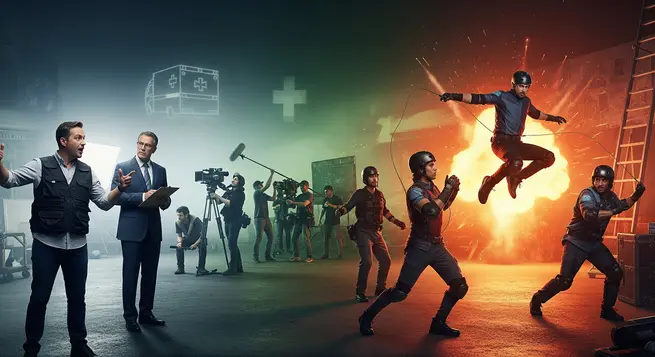
Film sets involve a lot of moving parts, particularly when high-risk stunts are involved. Maintaining safety requires strict coordination between professionals.
This quiz focuses on the roles of stunt teams, the mechanics of production insurance, and how safety protocols shape daily operations on set.
Check out our stunt choreography page for more depth, read about troubled film productions, or study cinematography techniques.
What is the primary role of a professional stunt team in film production?
Real weapons are mandatory for all stunt work.
Real weapons are mandatory for all stunt work.
A stunt double is exclusively used for talking roles.
A stunt double is exclusively used for talking roles.
Stunt coordinators are unnecessary for action scenes.
Stunt coordinators are unnecessary for action scenes.
The stunt team is responsible for performing dangerous physical feats.
The stunt team is responsible for performing dangerous physical feats.
In the context of filmmaking, what is an ‘outtake’?
The finished trailer for the movie.
The finished trailer for the movie.
Footage captured during a project that was not meant for the final cut.
Footage captured during a project that was not meant for the final cut.
A high-definition recreation of the scene.
A high-definition recreation of the scene.
Promotional studio interviews.
Promotional studio interviews.
Which of the following is considered a standard best practice in modern professional stunt coordination?
Life-threatening incidents are standard procedure for entertainment.
Life-threatening incidents are standard procedure for entertainment.
Stunt work is governed by strictly enforced safety protocols.
Stunt work is governed by strictly enforced safety protocols.
Ambulance footage is rarely real; it is almost always faked.
Ambulance footage is rarely real; it is almost always faked.
Safety is compromised to save money.
Safety is compromised to save money.
Which statement best describes the role of insurance in professional film production?
Film productions are generally required to carry specialized high-risk insurance policies.
Film productions are generally required to carry specialized high-risk insurance policies.
Film production insurance automatically covers all illegal activities during filming.
Film production insurance automatically covers all illegal activities during filming.
No film production studio is legally allowed to use insurance for stunt injuries.
No film production studio is legally allowed to use insurance for stunt injuries.
Medical bills for the injured party are typically covered by the stunt performer’s personal health plan only.
Medical bills for the injured party are typically covered by the stunt performer’s personal health plan only.
What is a necessary logistical step when planning a major, high-risk stunt scene?
They are only used in low-budget indie projects.
They are only used in low-budget indie projects.
They must be coordinated with fire and emergency services.
They must be coordinated with fire and emergency services.
They are always filmed in complete isolation with no crew present.
They are always filmed in complete isolation with no crew present.
They ensure zero impact on production timelines.
They ensure zero impact on production timelines.
Which medical reality is acknowledged regarding a ‘broken skull’ injury?
Skull fractures can only happen during underwater stunts.
Skull fractures can only happen during underwater stunts.
All stunt performers expect a skull fracture as a normal work outcome.
All stunt performers expect a skull fracture as a normal work outcome.
A skull fracture is a severe medical emergency requiring urgent imaging.
A skull fracture is a severe medical emergency requiring urgent imaging.
A skull fracture is a minor cosmetic injury.
A skull fracture is a minor cosmetic injury.
Why were early action films often associated with higher injury rates compared to modern high-budget films?
The director’s vision is more important than safety codes.
The director’s vision is more important than safety codes.
Stunt teams did not exist in the 20th century.
Stunt teams did not exist in the 20th century.
Insurance companies were often eager to pay for high-risk stunts.
Insurance companies were often eager to pay for high-risk stunts.
Safety protocols and union regulations were less stringent.
Safety protocols and union regulations were less stringent.
What does the inclusion of real ambulance/emergency footage in a project’s outtakes often signify?
It suggests a failure in safety planning and mitigation.
It suggests a failure in safety planning and mitigation.
It is a mandatory addition to all theatrical film releases.
It is a mandatory addition to all theatrical film releases.
It proves the movie had a very large budget.
It proves the movie had a very large budget.
It is standard practice for insurance adjusters to request it.
It is standard practice for insurance adjusters to request it.
Why are recordings of on-set emergencies frequently withheld from the general public?
They are the only scenes that studios market to insurance companies.
They are the only scenes that studios market to insurance companies.
They are legally required to be public records.
They are legally required to be public records.
They are often omitted by studios to protect their public image and mitigate liability.
They are often omitted by studios to protect their public image and mitigate liability.
They are the most profitable part of a film’s release.
They are the most profitable part of a film’s release.
Which member of a film crew is responsible for the safety and design of a dangerous physical action sequence?
A casting director.
A casting director.
A stunt coordinator.
A stunt coordinator.
A production accountant.
A production accountant.
A continuity supervisor.
A continuity supervisor.
Why is a thorough ‘risk assessment’ performed before a major stunt?
It prevents the use of digital stunt doubles.
It prevents the use of digital stunt doubles.
It is a common requirement for high-risk stunt coverage.
It is a common requirement for high-risk stunt coverage.
It is universally banned by international stunt federations.
It is universally banned by international stunt federations.
It is a standard clause for all actors in a film.
It is a standard clause for all actors in a film.
If an insurance company decides it ‘would not cover him’ for a specific stunt, what is the most likely reason?
An accident during a scheduled rehearsal.
An accident during a scheduled rehearsal.
Negligence during a stunt.
Negligence during a stunt.
Standard equipment failure.
Standard equipment failure.
An uninsurable ‘high-risk’ activity.
An uninsurable ‘high-risk’ activity.
How do professional stunt teams typically interact with the film’s director during pre-production?
Stunt teams are fully autonomous and ignore director feedback.
Stunt teams are fully autonomous and ignore director feedback.
Stunt teams are only hired after a stunt is already completed.
Stunt teams are only hired after a stunt is already completed.
Stunt teams collaborate with directors to ensure safety while achieving the visual goal.
Stunt teams collaborate with directors to ensure safety while achieving the visual goal.
Stunt teams have no say in how stunts are performed.
Stunt teams have no say in how stunts are performed.
What is the primary function of a stunt air-bag or mat when filming a fall?
It is required for all films regardless of the stunts involved.
It is required for all films regardless of the stunts involved.
It is only used for stunts involving fire.
It is only used for stunts involving fire.
It improves the realism of the stunt.
It improves the realism of the stunt.
It is a fundamental safety tool used to absorb impact.
It is a fundamental safety tool used to absorb impact.
How do comprehensive production insurance policies work regarding risk?
They are considered optional in almost all modern productions.
They are considered optional in almost all modern productions.
They are always provided at no cost by the government.
They are always provided at no cost by the government.
They require premiums to be paid, which increase with the risk of the activity.
They require premiums to be paid, which increase with the risk of the activity.
They provide 100% coverage forever.
They provide 100% coverage forever.
In the film industry, what is the direct consequence of a performer choosing to perform a ‘self-insured’ stunt?
Increased budget for safety equipment.
Increased budget for safety equipment.
The hiring of a more experienced stunt coordinator.
The hiring of a more experienced stunt coordinator.
Reduced insurance availability for the stunt.
Reduced insurance availability for the stunt.
The mandatory use of a stunt double for the performer.
The mandatory use of a stunt double for the performer.
What is the operational responsibility of on-set medics or paramedics?
They ensure medical professionals are on standby during high-risk production.
They ensure medical professionals are on standby during high-risk production.
They serve as extras in the background of scenes.
They serve as extras in the background of scenes.
They are prohibited from film sets.
They are prohibited from film sets.
They are prohibited from using real medicine.
They are prohibited from using real medicine.
Which factor most significantly hinders an independent filmmaker’s ability to pull off dangerous stunts?
The ‘no insurance’ hurdle for risky maneuvers.
The ‘no insurance’ hurdle for risky maneuvers.
Proper site assessments.
Proper site assessments.
Computer-generated imagery.
Computer-generated imagery.
Equipment fail-safes.
Equipment fail-safes.
Why are certain complex stunts frequently redesigned or simplified during the production process?
The director usually performs the stunt themselves.
The director usually performs the stunt themselves.
The budget for stunts is usually zero.
The budget for stunts is usually zero.
The insurance companies offer bonuses for real injuries.
The insurance companies offer bonuses for real injuries.
The safety requirements often make it impossible to film certain high-stakes actions.
The safety requirements often make it impossible to film certain high-stakes actions.
In an educational context, why might footage of an unplanned on-set injury be analyzed by stunt professionals?
To demonstrate the dangers involved in stunt work.
To demonstrate the dangers involved in stunt work.
To glorify the injuries of the performer.
To glorify the injuries of the performer.
To teach students about anatomy.
To teach students about anatomy.
To replace the need for professional stunt coordinators.
To replace the need for professional stunt coordinators.
How are professional stunt performers generally protected when working under a standard large-studio contract?
They are almost never included in any legal coverage.
They are almost never included in any legal coverage.
They are typically covered by the studio’s umbrella liability policy.
They are typically covered by the studio’s umbrella liability policy.
They are only covered if the performer is a union member.
They are only covered if the performer is a union member.
They are covered by the performer’s private homeowners’ insurance.
They are covered by the performer’s private homeowners’ insurance.
Why is ‘broken skull’ a term that triggers immediate concern for insurance adjusters?
The ‘Broken Skull’ is a common term for a stunt-only award.
The ‘Broken Skull’ is a common term for a stunt-only award.
The term refers specifically to the intensity and danger of head injuries.
The term refers specifically to the intensity and danger of head injuries.
The term is used to describe an insurance-mandated stunt.
The term is used to describe an insurance-mandated stunt.
The term is an industry standard for the name of the camera used to film accidents.
The term is an industry standard for the name of the camera used to film accidents.
You can do better
Not bad
Great!
If you enjoy this, visit our pages on Golden Age Hollywood, acting styles, or film noir.