

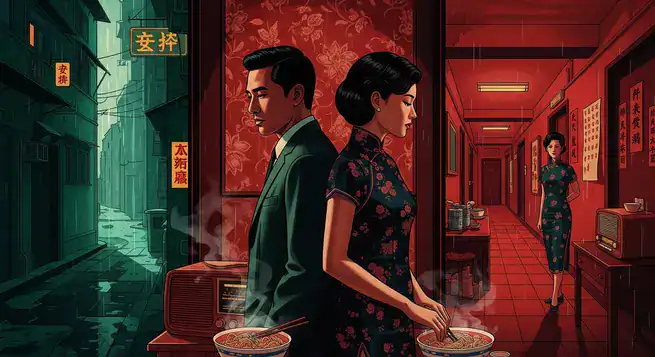
Wong Kar-wai’s In the Mood for Love is a landmark of contemporary cinema. Its lingering shots and deep sensory focus define a unique style that has left a lasting impact on how stories are framed on screen.
This quiz covers the production history and specific artistic choices that shaped the film. You will see questions about the collaboration between the director and leads, the use of color and music to build tension, and the long, non-traditional shooting process.
If you like this style of film, you might enjoy our look at East Asian cinema, the history of cinematography, and the craft behind scores and soundtracks.
Who directed the 2000 romantic drama ‘In the Mood for Love’?
Edward Yang
Edward Yang
Hou Hsiao-hsien
Hou Hsiao-hsien
Ang Lee
Ang Lee
Wong Kar-wai
Wong Kar-wai
Which actor played the role of Chow Mo-wan?
Takeshi Kaneshiro
Takeshi Kaneshiro
Leslie Cheung
Leslie Cheung
Andy Lau
Andy Lau
Tony Leung Chiu-wai
Tony Leung Chiu-wai
Who starred as the female lead, Su Li-zhen, in ‘In the Mood for Love’?
Zhang Ziyi
Zhang Ziyi
Gong Li
Gong Li
Faye Wong
Faye Wong
Maggie Cheung
Maggie Cheung
Approximately how long did the production of ‘In the Mood for Love’ last?
6 months
6 months
24 months
24 months
15 months
15 months
3 months
3 months
What does the long production time of ‘In the Mood for Love’ primarily symbolize in film history?
A chaotic production life cycle
A chaotic production life cycle
The exact musical score chosen for the scenes
The exact musical score chosen for the scenes
The influence of traditional Chinese opera
The influence of traditional Chinese opera
The specific color palette used in the film
The specific color palette used in the film
What was notable about the tears shed by Tony Leung during certain emotional scenes in the film?
A technical error in the editing room
A technical error in the editing room
A planned script requirement
A planned script requirement
The actor’s dissatisfaction with the director
The actor’s dissatisfaction with the director
Real emotions captured on camera
Real emotions captured on camera
What major factor contributed to the lengthy 15-month shooting process?
The improvised nature of the script
The improvised nature of the script
The film’s low budget initially planned by the studio
The film’s low budget initially planned by the studio
The lack of rehearsals for the actors
The lack of rehearsals for the actors
The extremely small crew size during filming
The extremely small crew size during filming
In terms of storytelling, for what unconventional editing practice is Wong Kar-wai famous, as seen in this film’s production?
Studio intervention that halted progress
Studio intervention that halted progress
The director’s habit of abandoning sequences entirely
The director’s habit of abandoning sequences entirely
A series of natural disasters on set
A series of natural disasters on set
The lead actor falling ill during production
The lead actor falling ill during production
In what time period and setting does ‘In the Mood for Love’ take place?
1960s Hong Kong
1960s Hong Kong
1950s Taipei
1950s Taipei
1940s Shanghai
1940s Shanghai
1980s Macau
1980s Macau
Which celebrated cinematographer collaborated with Wong Kar-wai on this film?
Christopher Doyle
Christopher Doyle
Emmanuel Lubezki
Emmanuel Lubezki
Zhao Fei
Zhao Fei
Roger Deakins
Roger Deakins
Who composed the iconic, recurring waltz theme heard throughout the film?
Ryuichi Sakamoto
Ryuichi Sakamoto
Tan Dun
Tan Dun
Joe Hisaishi
Joe Hisaishi
Shigeru Umebayashi
Shigeru Umebayashi
Which location serves as a recurring, claustrophobic setting for the protagonists’ encounters?
The intimate space of the apartment corridor
The intimate space of the apartment corridor
A bright, modern office building in the center of town
A bright, modern office building in the center of town
A train station platform at midnight
A train station platform at midnight
A sprawling outdoor market in rainy weather
A sprawling outdoor market in rainy weather
What event initially brings the two main characters together?
A mutual love for classical literature
A mutual love for classical literature
A shared interest in martial arts magazines
A shared interest in martial arts magazines
A missing umbrella left at a restaurant
A missing umbrella left at a restaurant
The discovery that their respective spouses are having an affair
The discovery that their respective spouses are having an affair
What visual design element is famously used to mark the passage of time in the film?
The rapid editing style used during dialogue scenes
The rapid editing style used during dialogue scenes
The inconsistent lighting in the street scenes
The inconsistent lighting in the street scenes
The constant shift in weather patterns within the city
The constant shift in weather patterns within the city
The changing patterns of Maggie Cheung’s qipao dresses
The changing patterns of Maggie Cheung’s qipao dresses
Which film is considered a spiritual sequel to ‘In the Mood for Love’?
Days of Being Wild
Days of Being Wild
Happy Together
Happy Together
Ashes of Time
Ashes of Time
2046
2046
What is a consequence of the extended 15-month shooting schedule?
The entire film being shot on location in Singapore rather than Hong Kong
The entire film being shot on location in Singapore rather than Hong Kong
The intense dedication of the actors to stay in character for over a year
The intense dedication of the actors to stay in character for over a year
The script being finalized before a single frame was shot
The script being finalized before a single frame was shot
The focus on only two characters in every single scene
The focus on only two characters in every single scene
Why was the collaborative process between the director and the actors so unusual during filming?
The director often felt frustrated by the lack of completed scenes
The director often felt frustrated by the lack of completed scenes
The film was originally intended as a documentary about waitstaff
The film was originally intended as a documentary about waitstaff
The actors were heavily involved in the writing process daily
The actors were heavily involved in the writing process daily
Most of the original cast quit due to the lack of clear direction
Most of the original cast quit due to the lack of clear direction
Which thematic core defines the relationship between the two main characters?
The thrill of a scandalous high-stakes romance
The thrill of a scandalous high-stakes romance
The joy of eventual resolution and happiness
The joy of eventual resolution and happiness
A feeling of repressed longing and missed opportunities
A feeling of repressed longing and missed opportunities
The comedic relief found in neighborhood gossip
The comedic relief found in neighborhood gossip
Who are the ‘ghost’ characters that loom over the film, driving the narrative but appearing only as shadows or voices?
A child who is never shown onscreen
A child who is never shown onscreen
A secret agent shadowing the couple
A secret agent shadowing the couple
Unseen spouses
Unseen spouses
A landlord who threatens evictions constantly
A landlord who threatens evictions constantly
In the final scenes involving the protagonist, where does he whisper his secret into a stone wall?
The Forbidden City in Beijing
The Forbidden City in Beijing
Angkor Wat in Cambodia
Angkor Wat in Cambodia
The Great Wall of China
The Great Wall of China
A remote beach in Vietnam
A remote beach in Vietnam
In the context of a film’s development, what does the term ‘abandoned narrative elements’ primarily refer to?
The discarding of initial story drafts that profoundly reshaped the final plot.
The discarding of initial story drafts that profoundly reshaped the final plot.
The destruction of all existing footage during post-production due to technical errors.
The destruction of all existing footage during post-production due to technical errors.
The director’s unscripted ideas for a sequel that were never seriously considered.
The director’s unscripted ideas for a sequel that were never seriously considered.
The decision to remove an entire sub-plot and character arc after principal photography.
The decision to remove an entire sub-plot and character arc after principal photography.
Which of these social dynamics most often forms the primary conflict for film protagonists navigating personal relationships?
The historical clash between different cultural traditions.
The historical clash between different cultural traditions.
The legal restrictions imposed by a rigid government system.
The legal restrictions imposed by a rigid government system.
The widespread economic inequality affecting their community.
The widespread economic inequality affecting their community.
The tension between individual desires and prevailing societal expectations.
The tension between individual desires and prevailing societal expectations.
You can do better
Not bad
Great!
If you enjoy this kind of analysis, we have other pages that cover troubled film productions, the nuances of romance movies, and the legacy of notable film directors.