


Italian Neorealism and the works of Federico Fellini changed cinema forever. This movement brought raw, emotional stories to the screen, often using non-professional actors and real locations to capture the daily struggles of post-war Italy.
This quiz focuses on specific milestones, including foundational films and the evolution of Fellini’s surrealist style. You will find questions about directors, iconic scenes, and behind-the-scenes facts that defined this cinematic era.
Check out our spotlight on auteurs, broaden your palate with European cinema hits, or study silent film history.
Which 1945 film is widely considered the foundational work of Italian Neorealism, depicting the Resistance in occupied Rome?
Rome, Open City
Rome, Open City
Shoeshine
Shoeshine
Bicycle Thieves
Bicycle Thieves
Paisan
Paisan
Which production method was central to the aesthetic of early Italian Neorealism?
Location shooting and non-professional actors
Location shooting and non-professional actors
High-fantasy storytelling and special effects
High-fantasy storytelling and special effects
The use of professional actors only
The use of professional actors only
Lavish studio sets and high-key lighting
Lavish studio sets and high-key lighting
In which De Sica classic does a man desperately search the streets of Rome for his stolen bicycle?
Miracle in Milan
Miracle in Milan
Umberto D.
Umberto D.
The Children Are Watching Us
The Children Are Watching Us
Bicycle Thieves
Bicycle Thieves
Before his directorial career, Federico Fellini contributed to the Neorealist movement primarily by working in which capacity?
Editing
Editing
Screenplay writing
Screenplay writing
Sound design
Sound design
Cinematography
Cinematography
What defines the ‘surrealist turn’ in Fellini’s cinematic career, starting in the mid-1950s?
Demands for stricter government censorship
Demands for stricter government censorship
A shift toward psychological and dreamlike narratives
A shift toward psychological and dreamlike narratives
Increased reliance on documentary footage
Increased reliance on documentary footage
A return to silent film conventions
A return to silent film conventions
Which 1954 film serves as a pivotal bridge between Fellini’s neorealist roots and his later expressionistic style?
La Dolce Vita
La Dolce Vita
La Strada
La Strada
Nights of Cabiria
Nights of Cabiria
I Vitelloni
I Vitelloni
What iconic scene in ‘La Dolce Vita’ serves as a biting social commentary on the exploitation of faith for spectacle?
A circus performer who finds redemption
A circus performer who finds redemption
A journalist’s search for genuine love
A journalist’s search for genuine love
A religious procession that fails to find a miracle
A religious procession that fails to find a miracle
A thief who regrets his crimes
A thief who regrets his crimes
‘La Dolce Vita’ (1960) provides a sweeping, critical panorama of which aspect of Italian society?
The rise of Italian fashion houses
The rise of Italian fashion houses
Post-war poverty in Southern villages
Post-war poverty in Southern villages
Rome’s social elite and paparazzi culture
Rome’s social elite and paparazzi culture
The industrialization of Northern Italy
The industrialization of Northern Italy
Which sequence in ‘La Dolce Vita’ is regarded as one of the most famous moments in cinema history?
The final sequence on Fregene beach
The final sequence on Fregene beach
The motorcycle chase through the Appian Way
The motorcycle chase through the Appian Way
The party in the castle at Bassano di Sutri
The party in the castle at Bassano di Sutri
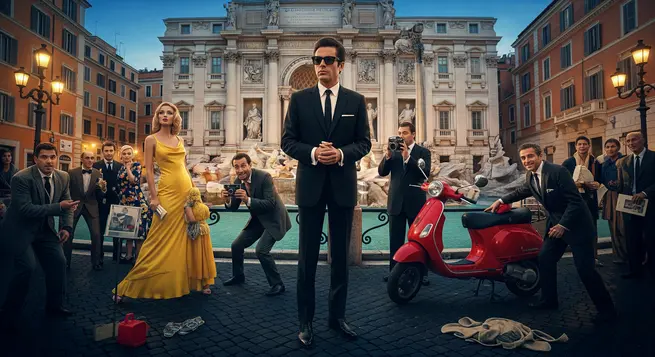
Anita Ekberg in the Trevi Fountain
Anita Ekberg in the Trevi Fountain
Who were the primary critics that condemned ‘La Dolce Vita’ for its perceived immorality and debauchery?
Students and intellectual critics
Students and intellectual critics
Trade unions representing film workers
Trade unions representing film workers
The Catholic Church and conservative politicians
The Catholic Church and conservative politicians
The Italian Communist Party
The Italian Communist Party
Which real-life figure inspired the character of the relentless photographer Paparazzo in ‘La Dolce Vita’?
Alberto Moravia
Alberto Moravia
Tazio Secchiaroli
Tazio Secchiaroli
Pier Paolo Pasolini
Pier Paolo Pasolini
Giorgio de Chirico
Giorgio de Chirico
Which actor became the definitive screen alter-ego for Federico Fellini, starring in ‘La Dolce Vita’ and ‘8½’?
Alberto Sordi
Alberto Sordi
Vittorio Gassman
Vittorio Gassman
Ugo Tognazzi
Ugo Tognazzi
Marcello Mastroianni
Marcello Mastroianni
‘8½’ centers on a protagonist struggling with creative block; what is his profession?
Film director
Film director
Conductor
Conductor
Writer
Writer
Painter
Painter
What does the title ‘8½’ signify in regard to Fellini’s career?
The number of films he had directed at that point
The number of films he had directed at that point
The number of scripts he rejected before filming
The number of scripts he rejected before filming
The number of major awards he had won
The number of major awards he had won
The number of years he spent in pre-production
The number of years he spent in pre-production
Unlike his earlier works, ‘8½’ focuses heavily on which thematic element?
The subconscious and memory
The subconscious and memory
The political climate of the Cold War
The political climate of the Cold War
The history of the Roman Empire
The history of the Roman Empire
The struggle for workers’ rights
The struggle for workers’ rights
What is the name of the protagonist in ‘8½’?
Guido Anselmi
Guido Anselmi
Marcello Rubini
Marcello Rubini
Zampanò
Zampanò
Augusto Rocca
Augusto Rocca
Where does a significant portion of the surreal events in ‘8½’ take place?
The crowded film studio office
The crowded film studio office
The beach with the whale carcass
The beach with the whale carcass
The luxury spa resort town
The luxury spa resort town
The circus tent
The circus tent
Which opening scene of ‘8½’ is celebrated for its abstract representation of mental paralysis and entrapment?
The flight over the beach at the start of the film
The flight over the beach at the start of the film
The final circular dance performance
The final circular dance performance
The fantasy sequence where the protagonist meets his deceased parents
The fantasy sequence where the protagonist meets his deceased parents
The Saraghina dance sequence
The Saraghina dance sequence
In one of the most famous dream sequences in ‘8½’, the protagonist is surrounded by what?
A harem representing his romantic history
A harem representing his romantic history
An army of critics judging his unfinished work
An army of critics judging his unfinished work
A series of historical figures questioning his talent
A series of historical figures questioning his talent
A group of producers forcing him to quit filmmaking
A group of producers forcing him to quit filmmaking
Which legendary composer created the musical score for ‘8½’?
Ennio Morricone
Ennio Morricone
Carlo Rustichelli
Carlo Rustichelli
Piero Piccioni
Piero Piccioni
Nino Rota
Nino Rota
Critics often view ‘8½’ as a meta-cinematic essay on which struggle?
The collapse of his personal life
The collapse of his personal life
The breakdown of his collaborative relationship with Mastroianni
The breakdown of his collaborative relationship with Mastroianni
The failure of his production company to secure funding
The failure of his production company to secure funding
The impossibility of creating art during a time of intense personal anxiety
The impossibility of creating art during a time of intense personal anxiety
Why is ‘8½’ lauded by film scholars as a quintessential example of auteur cinema?
It was the first film to feature a non-linear narrative
It was the first film to feature a non-linear narrative
It represents a return to classical Neorealist storytelling
It represents a return to classical Neorealist storytelling
It is considered a landmark of modernist cinema and self-reflexive art
It is considered a landmark of modernist cinema and self-reflexive art
It marks the final time Fellini would explore surrealist imagery
It marks the final time Fellini would explore surrealist imagery
You can do better
Not bad
Great!
If you enjoyed this overview of Italian classics, stick around to brush up on foreign language winners, learn more about camera techniques, or browse our cult classics.